
There is a point at which a live event stops evolving incrementally and instead resets the standard entirely. The 2026 edition of Ultra Music Festival represents that inflection point. Long recognized as one of the defining global platforms for electronic music, Ultra has now positioned itself at the forefront of something more consequential than programming or production scale. It is actively redesigning how a festival operates at a systems level—power, infrastructure, environmental impact—without compromising the intensity or precision that defines the experience on the ground.
What emerged in Miami was not simply another iteration of a major festival. It was a working model of how large-scale live events can transition away from legacy energy systems and toward a more controlled, efficient, and environmentally accountable architecture. At the center of that shift was a breakthrough that, until recently, had remained largely theoretical at this scale: a fully battery-powered main stage operating with zero onsite emissions.
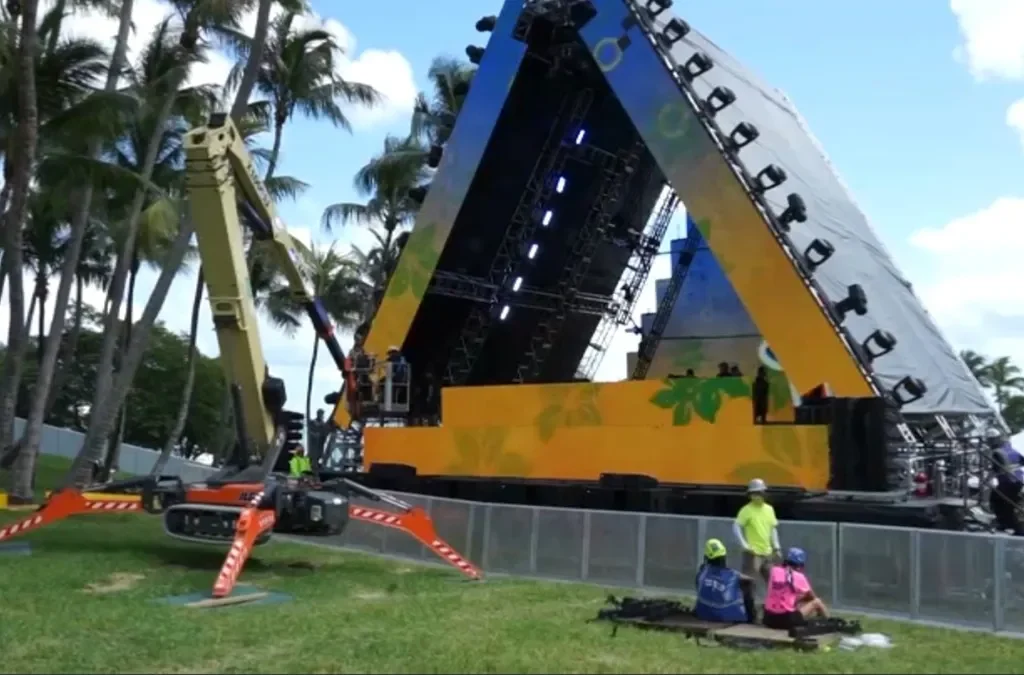
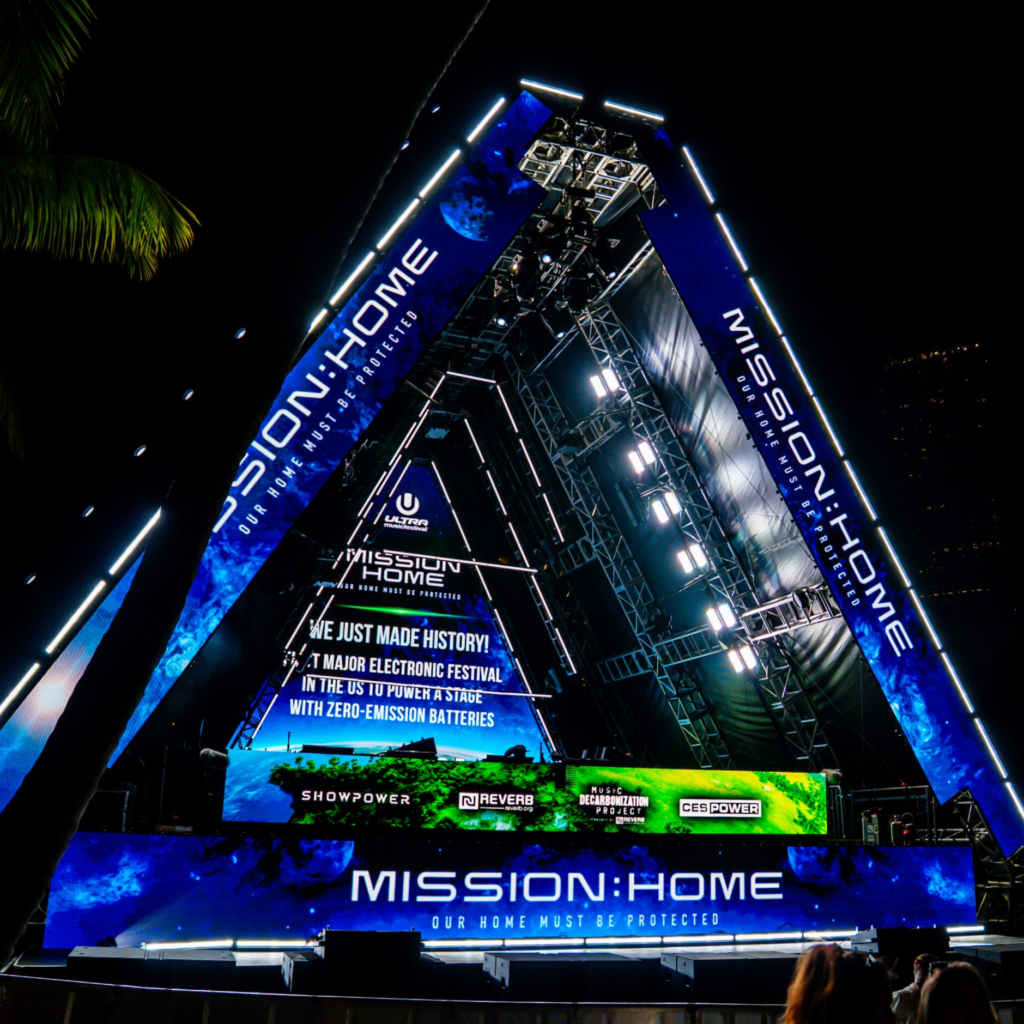
The RESISTANCE Cove Stage became the focal point of that transformation. In 2026, it was reengineered to run entirely on the Showpower SmartGrid™ battery system, a modular energy platform designed to deliver sustained, high-capacity output for live production environments. With a capacity of approximately 330 kWh, the system supported more than ten hours of continuous operation—powering audio, lighting, and visual infrastructure without the need for diesel generators. In practical terms, that eliminated the most persistent environmental liabilities associated with festival production: fuel combustion, emissions, and mechanical noise.
This was not an isolated technical experiment. It was the result of coordinated execution across multiple stakeholders operating within Ultra’s Mission: Home framework. In collaboration with REVERB and its Music Decarbonization Project, alongside CES Power and Showpower, Ultra transitioned the Cove Stage into a fully contained energy system that could deliver broadcast-quality performance standards while operating emission-free onsite. The implications extend beyond sustainability metrics. Removing generator noise alone alters the acoustic environment, allowing for greater clarity and dynamic range in live sound delivery—an outcome that directly enhances the audience experience.
The strategic importance of this development becomes clearer when placed within the broader context of Ultra’s 2026 operations. Four of the festival’s seven stages—Cove, Live, UMF Radio, and Oasis—were executed without diesel generators, either through battery systems or direct integration with Miami’s electrical grid. This represents a majority shift in power infrastructure, effectively redefining what is possible at scale within a dense, multi-stage urban festival footprint.
The distinction between onsite and total emissions is central to understanding the significance of this achievement. By eliminating combustion-based power generation within the event perimeter, Ultra has removed direct emissions from Bayfront Park during operational hours. The energy powering these systems is pre-charged through existing grid infrastructure, meaning that while upstream emissions may still exist depending on the energy mix, the immediate environmental and experiential impact on-site is fundamentally different. It is quieter, cleaner, and operationally more efficient.
Ultra has not treated this as a standalone milestone. It is embedded within Mission: Home, the festival’s long-term sustainability platform, which has expanded into a comprehensive framework encompassing waste diversion, material recovery, energy optimization, and community impact. Since its launch, the program has eliminated millions of single-use plastics, diverted substantial volumes of waste from landfills, and implemented a circular approach to materials that extends the lifecycle of event infrastructure beyond a single weekend.
The integration of these systems is what distinguishes Ultra’s approach. Energy is not addressed in isolation from waste, nor is sustainability treated as a secondary layer applied after production decisions are made. It is built into the operational design from the outset. That is why partnerships matter in this context. Organizations such as REVERB bring domain expertise in environmental strategy, while infrastructure partners provide the technical capability to execute at scale. Ultra’s role is to align those inputs into a cohesive model that functions in real time under the pressures of a live event environment.
The environmental benefits are immediate and measurable. The elimination of diesel generators removes localized air pollution, reduces carbon output at the point of use, and eliminates the logistical burden associated with fuel transport and storage. Noise reduction is equally significant, particularly in an urban setting where sound management is both a technical and regulatory concern. At the same time, reliability remains non-negotiable. The SmartGrid system’s ability to deliver stable, uninterrupted power across extended performance windows demonstrates that sustainability and performance integrity are not mutually exclusive.
What is equally important is the signaling effect this creates across the industry. Ultra is not operating in a vacuum. As part of Ultra Worldwide, its operational decisions have downstream influence across a network of international events. By proving that large-scale stages can function without onsite emissions, Ultra is effectively establishing a new baseline expectation for festivals operating at the highest tier.
That expectation extends to artists, production teams, and audiences. Sustainability is no longer an abstract concept discussed in parallel to performance—it is integrated into the experience itself. Attendees are not just witnessing a technological shift; they are participating in it, whether through reduced environmental impact onsite or through broader initiatives that encourage awareness and accountability around travel and consumption.
The 2026 edition of Ultra Music Festival should be understood as a transition point rather than a finished product. The infrastructure deployed at the RESISTANCE Cove Stage is scalable, but it also represents an early-stage implementation of what will likely become a more refined and widespread standard. As grid systems evolve and renewable energy integration increases, the upstream component of emissions will continue to improve, bringing the concept of fully zero-emission events closer to reality.
From an operational standpoint, Ultra has demonstrated that the constraints traditionally associated with sustainability—limited power capacity, reduced performance quality, increased risk—are no longer defining factors. Instead, they are engineering challenges that can be addressed through coordinated design, strategic partnerships, and a willingness to invest in long-term solutions.
This is where Ultra separates itself from the broader festival landscape. It is not simply responding to external pressure to reduce its environmental footprint. It is proactively redesigning its infrastructure in a way that aligns with the future direction of live events. That requires a different level of commitment, one that prioritizes system-wide change over incremental adjustments.
The result is an event that continues to deliver on its core promise—world-class electronic music production at an unmatched scale—while simultaneously redefining the parameters of how that experience is produced. Ultra Music Festival in 2026 did not dilute its identity to achieve this shift. It reinforced it by proving that innovation, which has always been central to electronic music culture, applies as much to infrastructure as it does to sound.
In practical terms, the RESISTANCE Cove Stage stands as a working prototype for the next generation of live events. It demonstrates that zero-emission, high-capacity production is not only possible, but viable within the constraints of a major U.S. festival. More importantly, it establishes a direction that others in the industry will now be expected to follow.
Ultra has moved beyond setting trends in music. It is now setting standards in how music is delivered.