
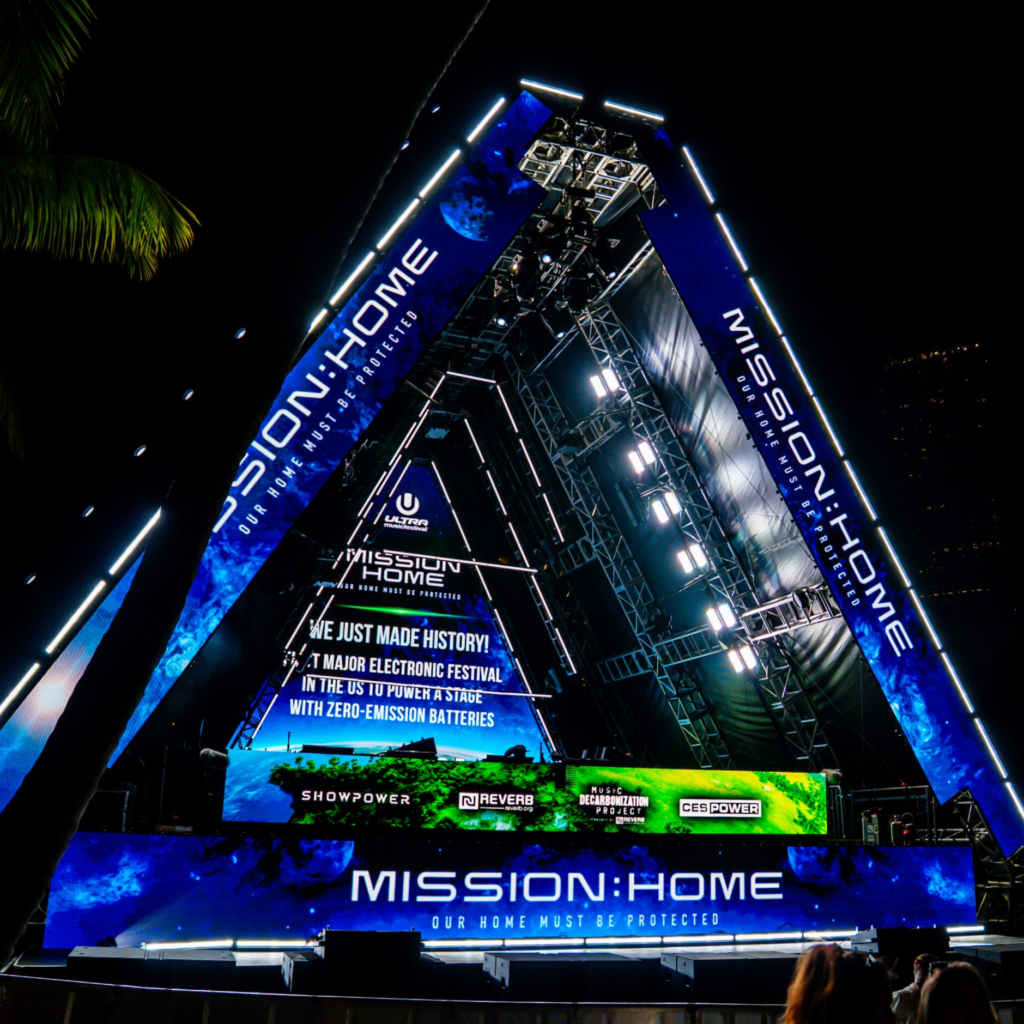
There are very few live events that can credibly claim to shape the trajectory of an entire genre. Ultra Music Festival is one of them. What began as a beachfront gathering in Miami has evolved into a global institution—an anchor point for electronic music culture and a proving ground for production, technology, and audience-scale innovation. But in its current phase, Ultra is no longer defined solely by lineup density or stage spectacle. It is now operating as a blueprint for what large-scale live events must become in a climate-conscious, infrastructure-driven era.
The modern Ultra experience is engineered at the intersection of performance and systems design. Every element—audio delivery, stage architecture, power distribution, waste management—has been rethought not just for scale, but for efficiency, resilience, and environmental accountability. That shift is most visible in the festival’s sustainability platform, Mission: Home, a program that has quietly become one of the most comprehensive environmental frameworks in the global festival circuit.
Launched in 2019, Mission: Home is not a marketing layer or a symbolic gesture. It is an operational system with more than 65 active initiatives targeting waste diversion, emissions reduction, material reuse, and community impact. The scope alone places Ultra in a different category than most major festivals. Nearly 400,000 pounds of waste have been diverted from landfills through aggressive sorting and recycling systems, while more than 2.6 million single-use plastic items have been eliminated from the event footprint. These are not marginal gains—they represent a structural overhaul of how a temporary city operates over a multi-day period.
The waste strategy extends beyond collection. Ultra’s “Leave No Trace” campaign introduces behavioral enforcement through education, using on-site teams to guide attendee participation in real time. The approach acknowledges a core reality of large gatherings: sustainability outcomes depend as much on crowd behavior as they do on infrastructure. By embedding that awareness into the fan experience, Ultra is effectively turning its audience into an active component of its environmental system.
Material lifecycle management has also been reimagined. Post-event assets—construction wood, vinyl signage, staging materials—are no longer treated as disposable. They are redirected into secondary use streams, from donations to local artists to upcycled merchandise production. This is circular economy thinking applied at festival scale, reducing waste while creating downstream value that extends beyond the event itself.
Food recovery is another critical dimension. Through its partnership with Miami Rescue Mission, Ultra has redirected more than 65,000 pounds of surplus food to local communities. That initiative reframes excess not as inefficiency, but as an opportunity for impact—aligning large-scale event logistics with real-world community needs.
These cumulative efforts have not gone unnoticed. Ultra earned certification from A Greener Future, marking it as the first U.S. festival of its scale in over a decade to receive that level of recognition. In an industry often criticized for environmental excess, that distinction carries weight.
However, the most significant transformation at Ultra is happening in its energy infrastructure. Historically, large festivals have relied on diesel generators—reliable but emissions-heavy systems that power everything from main stages to vendor operations. Ultra has made a deliberate move away from that model, replacing it with a hybridized approach that prioritizes grid integration and advanced battery systems.
The 2026 edition marked a turning point. The RESISTANCE Cove Stage became the first large-scale stage at a major U.S. electronic festival to operate with zero onsite emissions. This was achieved through the deployment of the Showpower SmartGrid™ Battery System, a modular energy solution originally engineered for stadium-level touring productions. The system is pre-charged using Miami’s electrical grid, allowing it to deliver sustained, high-fidelity power for more than ten hours without the combustion, noise, or air pollution associated with diesel generators.
From a production standpoint, this is not a minor upgrade. It fundamentally alters the acoustic and environmental conditions of a stage environment. Without generator noise, sound clarity improves. Without fuel combustion, air quality within the venue is cleaner. And without the logistical demands of fuel transport and storage, operational complexity is reduced.
At the same time, Ultra has transitioned several of its other major stages—including Live, UMF Radio, and Oasis—to direct grid power. Working alongside CES Power and Showpower, the festival has implemented a Smart Power Plan that continuously monitors energy usage and optimizes distribution across the site. The result is a majority generator-free festival footprint, with four of seven stages operating without onsite emissions in 2026.
This is where the conversation becomes more nuanced. The term “zero-emission” in this context refers specifically to onsite emissions—what is produced within the boundaries of Bayfront Park during the event. Because the battery systems are charged using the local grid, the total lifecycle emissions depend on the energy mix feeding that grid. If fossil fuels are part of that mix, emissions are effectively shifted upstream rather than eliminated entirely.
That distinction matters, particularly as sustainability claims in live events come under increasing scrutiny. But it does not diminish the operational significance of Ultra’s approach. Eliminating onsite emissions at this scale is a substantial step forward, reducing immediate environmental impact while creating a pathway for further decarbonization as grid infrastructure evolves.
Ultra’s broader climate strategy accounts for that gap. Through its partnership with Climate Futures, the festival calculates its total production footprint and invests in forestry and carbon offset projects to counterbalance remaining emissions. The model is not perfect—no large-scale event is—but it represents a layered approach that combines reduction, substitution, and offsetting into a cohesive system.
Importantly, Ultra is also extending that framework to its audience. Through the 1PLANET app, attendees can measure and offset the carbon impact of their travel, effectively decentralizing responsibility and turning sustainability into a shared initiative between organizer and fan. In practical terms, it acknowledges that the largest portion of a festival’s footprint often comes from transportation, not onsite operations.
All of this is happening without compromising the core identity of Ultra as a performance-driven event. The festival continues to operate at the highest level of electronic music production, delivering large-scale stage design, cutting-edge visuals, and globally recognized talent across multiple genres and subcultures. What has changed is the underlying architecture supporting that experience.
Ultra is no longer just building stages. It is building systems—energy systems, waste systems, behavioral systems—that redefine what a modern festival can be. The implications extend well beyond Miami. As Ultra Worldwide continues to expand its footprint across international markets, these operational models are positioned to scale with it, influencing how festivals are designed and executed globally.
The broader takeaway is straightforward. The future of live events will not be determined solely by who can book the biggest lineup or build the most visually striking stage. It will be determined by who can operate at scale without ignoring environmental constraints. Ultra Music Festival is positioning itself at the front of that transition, not through rhetoric, but through implementation.
In that sense, Ultra’s evolution is less about reinvention and more about recalibration. It is taking the existing DNA of electronic music culture—innovation, energy, community—and applying it to the realities of a changing world. The result is an event that still delivers the intensity and spectacle its audience expects, while quietly redefining the standards by which that experience is measured.