
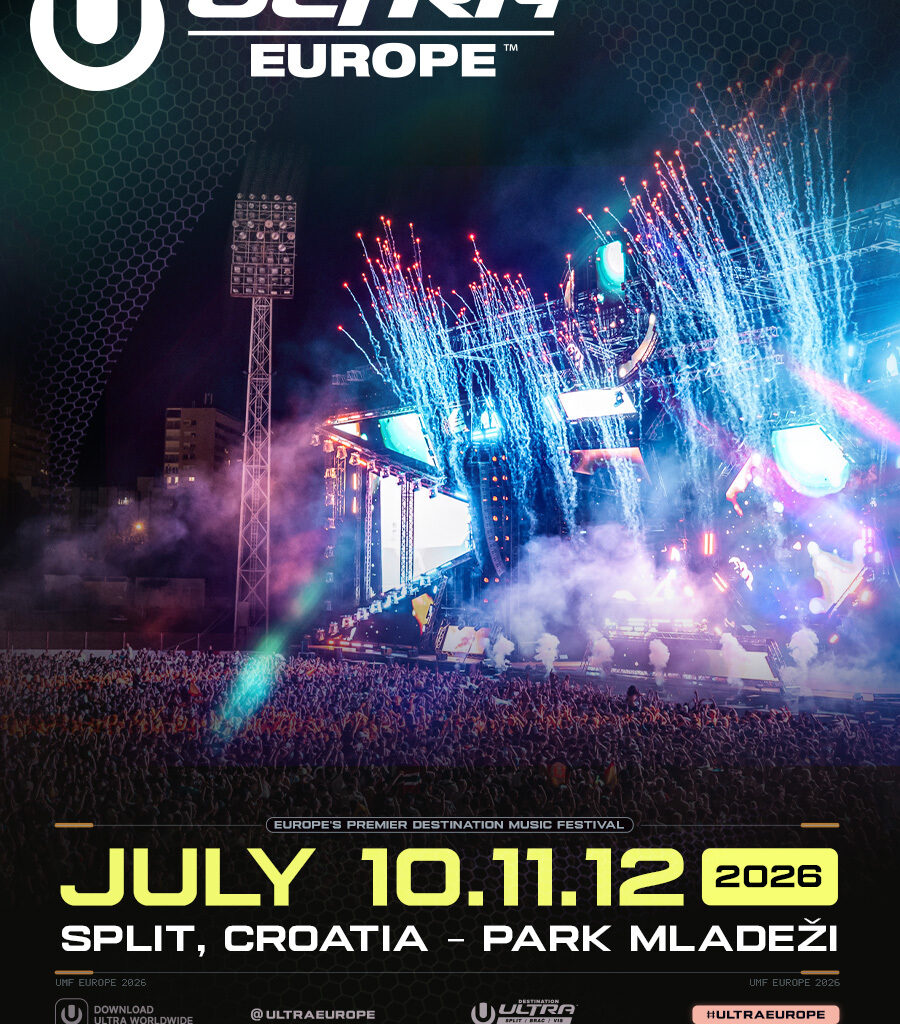
Split has a specific quality in early July that no other European festival city can replicate. The air comes off the Adriatic warm and clean, the ancient stone of Diocletian’s Palace glows differently after dark than it does at midday, and the harbor, lined for this one week each year with groups boarding catamarans to Brač and Vis and Hvar, takes on the specific energy of people who have traveled from everywhere on earth for a single purpose and feel entirely certain they made the right decision. The Romans built the emperor’s retirement palace here for a reason. Ultra Europe, which has occupied Park Mladeži, a few hundred meters from those same fourth-century walls, every July since 2013, has inherited something of that logic.
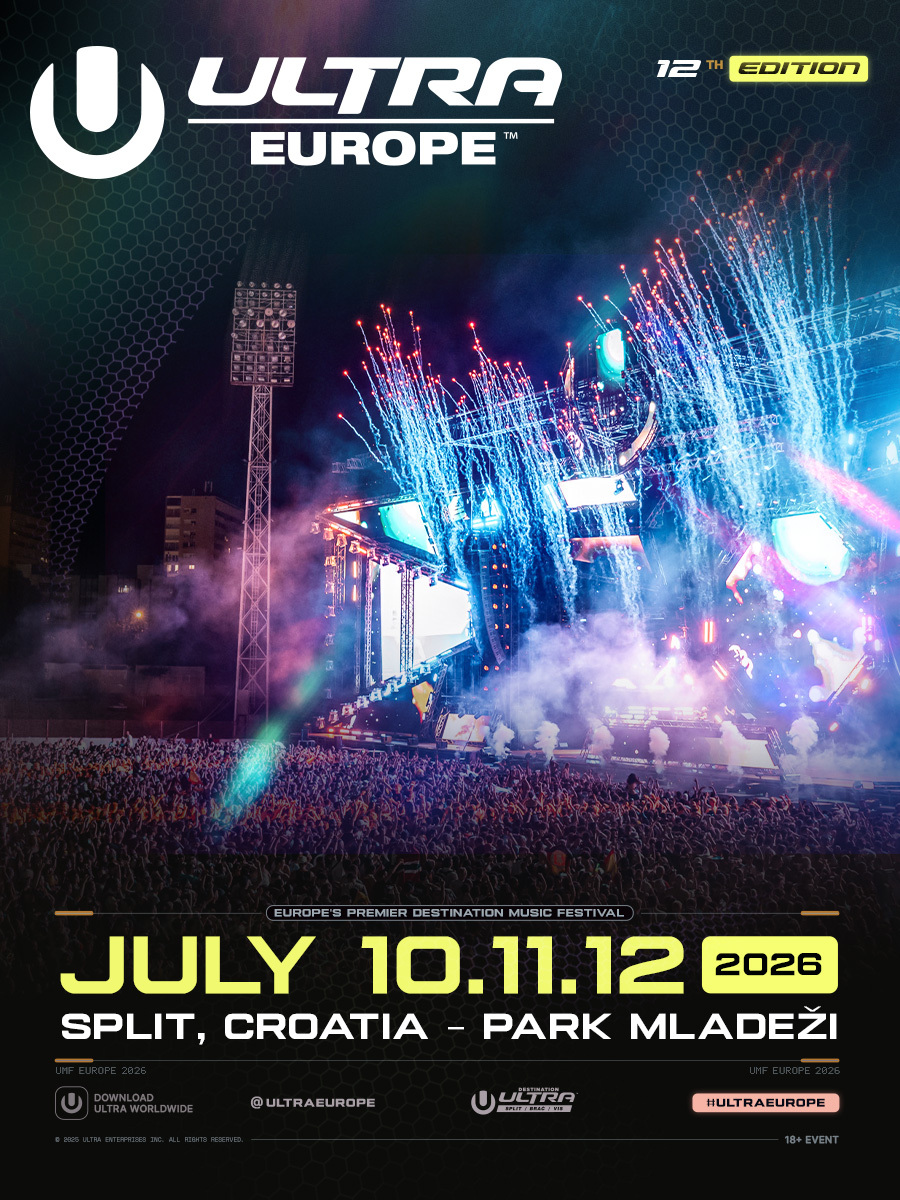
The 12th edition of Ultra Europe closed out on the night of July 12, 2026, and by any honest measure it represents the most ambitious and successful edition the festival has mounted since it first arrived on the Dalmatian coast. Over 150,000 attendees from more than 140 countries came through the gates across the three days. The global UMF TV broadcast pushed the reach of the weekend far beyond Park Mladeži, connecting the festival to audiences around the world who watched the #ULTRALIVE stream in real time. The fan footage spreading across social media in the 48 hours since the closing night ended tells a story of a crowd that understood it was participating in something exceptional.
Ultra Europe has always delivered at scale. The festival’s history at Park Mladeži includes appearances from Tiësto, Carl Cox, Steve Angello, Armin van Buuren, and Martin Garrix across editions that each set a new standard for what a stadium-format outdoor event could accomplish on the European festival circuit. Attendance has grown steadily since the event’s Croatian debut, the production has scaled with it, and the RESISTANCE stage, the underground pillar running simultaneously with the Main Stage each night, has cemented the festival’s credibility across both the commercial EDM and deeper techno communities in a way that few events of this size manage to sustain.
But 2026 felt different from the moment the Phase 1 lineup dropped, and the reason was one name that had never appeared on an Ultra Europe poster before: Calvin Harris. The announcement that Harris would make his Ultra Europe debut at the 2026 edition sent an immediate signal about what kind of summer this was going to be. Harris is not simply a popular DJ and producer. He is the artist who has, more than perhaps anyone in the past decade, demonstrated that electronic music and mainstream cultural relevance are not mutually exclusive, that a record built on synthesizers and programmed drums can reach the same emotional scale as the biggest guitar band anthems in history. His Ultra Europe debut in 2026, his first appearance at the festival despite the event’s decade-plus history, carried the weight of something long overdue. That booking alone might have been enough to make this edition a landmark. But Ultra Europe does not build landmark editions around a single booking. It layers them.
Alongside Harris, the Phase 1 announcement confirmed Martin Garrix, John Summit, FISHER, Dom Dolla, MAU P, Sara Landry, Miss Monique, I Hate Models, and WORSHIP, a first wave so comprehensive in its range and credibility that subsequent phases felt less like expansions and more like confirmation of what everyone already suspected. Phase 2 added Armin van Buuren, returning to Split for his annual A State of Trance celebration and this year marking 25 years of the brand that has made him one of the most recognizable presences in global dance music, alongside Hardwell, Afrojack, Oliver Heldens, DJ Snake, Adam Beyer, CamelPhat, Maddix, Nico Moreno, and Jamie Jones. The final wave brought BUNT., the German melodic house producer whose live sets operate at a different emotional register than most Main Stage acts; Plastik Funk; the return of trance staple Dash Berlin; and the back-to-back pairing of Ray Volpe and Sullivan King, whose crossover between electronic music and metal-adjacent bass production represents one of the more interesting creative directions currently operating in the space.
More than 150 artists across four stages across three nights, running from gates open at 8 PM through dawn at 5 AM each day. The set time architecture that Ultra Europe released in the days before the festival told its own story: Calvin Harris, Martin Garrix, and Dom Dolla were each handed 95-minute blocks, longer than the standard festival headliner allocation and a clear signal that the production team had planned these three sets as centrepieces rather than closers. John Summit, Hardwell, and FISHER were each allocated the 3:30 AM finishing slots on their respective nights, 90 minutes each, with the understanding that closing a three-day festival at dawn in Croatia requires a particular kind of artist and a particular kind of commitment.
The first night established immediately that this edition was not going to coast on the strength of its lineup alone. The Main Stage production, immersive LED architecture paired with the kind of pyrotechnics and laser work that travel poorly in photographs but make the actual experience of standing in Park Mladeži feel like standing inside a controlled detonation, was calibrated to a scale that made the venue feel both enormous and intimate at once. Oliver Heldens opened the evening’s peak-hour programming with the confidence of an artist who has been at this level long enough to know exactly what a warm-up crowd needs. Afrojack followed, bringing the energy of his recently premiered “Awake Tonight” collaboration, the track he unveiled live at Ultra Miami in March alongside David Guetta and Sia, his most significant joint project in fifteen years, to the Croatian crowd for the first time. DJ Snake connected the electronic and Latin music communities in his signature fashion, the kind of Main Stage performance that reminds audiences why his catalog reaches as far across genre lines as it does.
The RESISTANCE stage on Friday ran simultaneously with Miss Monique and Adam Beyer delivering the underground counterpart to the Main Stage programming. Beyer’s set, driving, precise, unapologetically heavy in the way Drumcode sets are supposed to be heavy, was one of the most discussed performances of the opening night among the segments of the crowd that came to Split specifically for the underground program. CamelPhat extended the techno programming through the early hours before John Summit closed Friday on the Main Stage. The Chicago DJ has earned his position as one of electronic music’s most effective closers by understanding, intuitively, how a crowd’s energy changes across the course of a long festival night and how to meet it precisely where it is rather than where the schedule says it should be. His 3:30 AM set ran through new material alongside the house tracks that have built his audience into one of the most engaged in the current scene, landing with the kind of coherence that only comes from an artist completely in command of the room.
Saturday built toward its two centrepieces relentlessly. Maddix set an early tone that carried through the pre-headliner hours, the high-energy big room production that the Saturday crowd at a festival of this scale consistently rewards. WORSHIP, the drum and bass collective whose inclusion in lineups of this scale signals how seriously major festivals are now taking that audience, brought an entirely different energy to the Main Stage and proved again why their bookings consistently outperform expectations.
Dom Dolla arrived at the midpoint of the evening having spent the past two years positioning himself as one of house music’s most reliable festival presences, an artist whose sets never feel like catalog playback because they are built in real time around the specific room and the specific crowd. His extended Main Stage set demonstrated that instinct at scale, the kind of performance that does not push any single individual moment into viral territory but leaves a crowd feeling collectively satisfied in a way that outlasts the night. Then came Calvin Harris, making his Ultra Europe debut thirteen years after the festival’s Croatian launch, delivering the kind of set that only an artist with his specific combination of catalog depth and production instincts can provide. Harris occupies a singular position in contemporary electronic music: he writes and produces records that function as both club tools and mainstream pop moments, and he understands intuitively how to sequence those records in a live context so that the emotional trajectory of the set follows the emotional trajectory of the crowd. His 95 minutes at Park Mladeži built from opening records that established authority and energy into the massive singalong moments that his catalog uniquely enables, ending with the crowd in a state of collective euphoria that is not easy to engineer even with the best material on earth. The post-festival response has been consistent: Harris delivered everything the booking promised, and then some.
Hardwell closed Saturday night. The Dutch artist’s relationship with Ultra Europe goes back to the festival’s earliest editions, and the understanding between him and this specific crowd, this specific venue, these specific flags waving in the Adriatic night air, is different from what he experiences at other festivals on the circuit. His 3:30 AM set opened with the forward-thinking production that has defined his recent work, incorporated new material alongside the catalog that first made his name at events of this size, and closed in the way that Park Mladeži responds to best, which is to say loudly, completely, and without reservation.
The closing night generated more social media discussion, more fan footage, and more immediate post-festival conversation than either of the two nights preceding it, and that is saying something given what Saturday delivered. The RESISTANCE stage on Sunday ran what was widely described in the immediate aftermath as its strongest single program of the 2026 edition. Will Atkinson, Nico Moreno, and Sara Landry constructed a closing night techno sequence that moved from melodic through hard and into genuinely punishing, in a progression that the RESISTANCE crowd received with the kind of physical response that good techno programming earns. I Hate Models closed the stage in the manner that hard techno sets at their best are supposed to close things: relentlessly, completely, with no diplomatic concessions to whatever the crowd might want instead of exactly what they need. The reception across the online community in the 48 hours since Sunday has confirmed what anyone in the room already knew, that the RESISTANCE stage at Ultra Europe 2026 was the most fully realized version of that program the festival has ever produced.
On the Main Stage, the closing night built through the early evening hours before arriving at its two most discussed performances of the entire weekend. Armin van Buuren delivered what he always delivers when operating in the right setting with the right crowd and the right material, which is a clinic. The A State of Trance 25th anniversary celebration has been a thread running through the 2026 festival circuit since Miami, and at Park Mladeži on Sunday, van Buuren brought that celebration to a crowd that has been following the brand long enough to understand exactly what the milestone means. His trance selections moved through the catalog with the confidence of an artist who has spent 25 years building an audience’s trust across every corner of the globe. In a particularly resonant moment, he and vocalist Sacha premiered their new collaboration “Everlasting” live, a world debut dropped in exactly the right room, in front of exactly the right audience, at exactly the right hour. The crowd chanted along across 43 tracks in a set that demonstrated why trance, at its best, delivers something emotionally distinct from any other corner of the electronic music world.
Martin Garrix followed, and in the post-festival conversation running across fan communities and music forums since the closing night ended, one specific moment from his set has been circulating more than any other, and it deserves the attention it’s receiving. Garrix opened his 95-minute Main Stage performance with a brand-new, unreleased intro edit, a seamless reconstruction of his 2014 classic “Tremor” rebuilt into a fresh progressive house weapon that the Park Mladeži crowd heard for the first time on Sunday night. It is precisely the kind of creative decision that separates artists who treat festival appearances as catalog playback from artists who treat them as genuine creative occasions: he took one of his most beloved records, rebuilt it without losing what made the original work, and dropped it as the opening statement of a set in front of tens of thousands of people who had no idea it was coming. From that opening forward, Garrix ran through several fully unreleased IDs alongside fresh festival remixes that had not been heard before Sunday. The combination of new material and the authority of a decade-plus of Ultra Europe performances made his closing set one of the most technically and emotionally complete Main Stage performances of the three-day run. Local Split police confirmed that the entire closing night passed without incident, a reflection of both the logistics operation that Ultra Europe deploys at scale and the character of a crowd that comes to the Dalmatian coast with one purpose.
FISHER closed out the full festival in the 3:30 AM final slot with exactly the energy that a closing set demands and exactly the irreverence that FISHER consistently brings to every situation: pure chaos management at premium scale, the catalog deployed with the confidence of someone who knows it works and the sense of humor of someone who would not do this job if it weren’t genuinely fun. The sun came up over the Adriatic with his closing sequence still moving through the crowd.
No honest accounting of Ultra Europe 2026 is complete without acknowledging the specific role that Split plays in making this festival what it is. Other festivals have better logistics. Other festivals have bigger budgets. But no other major European festival happens inside a city of this specific character, with ancient stone courtyards a fifteen-minute walk from the stages, an Adriatic waterfront that reframes the experience of any night that ends near dawn, and an old town that has been hosting people at the peak of their enthusiasm since the Roman emperor arrived here to retire in the early fourth century. Park Mladeži sits in the Meje district just outside the city’s western edge, transformed each July from a standard stadium and park complex into an open-air festival ground capable of accommodating crowd sizes that would strain most European venues. The Destination Ultra extended program, which runs the week surrounding the main three-day festival with island events on Brač and Vis, boat parties in the Adriatic, and RESISTANCE programming across multiple Croatian locations, essentially transforms what would already be one of the summer’s significant festival weekends into a five-to-six-day cultural experience that participants are still talking about months after it ends.
What the 12th edition of this festival demonstrated, across three nights and four stages and 150,000 attendees from 140 countries, is that the combination of the right venue, the right lineup, and the right production can still produce experiences that cannot be replicated by streaming footage, festival photography, or any description that relies on language alone. The fan footage circulating right now captures moments but not the experience. The experience was standing in Park Mladeži on Saturday night when Calvin Harris made his Ultra Europe debut, or in the RESISTANCE tent on Sunday when I Hate Models closed out the underground program, or in the crowd at 4 AM when FISHER was somewhere between his third and fourth second wind of the evening and the sun was beginning to lighten the Adriatic horizon to the east.
Those moments belong to the people who were there. The rest of us have the footage, the accounts, and the next edition to look forward to. Ultra Europe 2027 returns to Split, July 9 through 11, one year from now, the same Park Mladeži, the same walls of Diocletian’s Palace glowing across the water, the same crowd arriving from 140 countries for the same reason they always come. Because there is nothing else quite like this. There never has been.
Ultra Europe 2027 is scheduled for July 9 through 11 at Park Mladeži in Split, Croatia. Early access ticket information is available now at ultraeurope.com.