
165,000 people. 100 countries. A surprise Swedish House Mafia reunion nobody saw coming. World premieres that rewrote what a festival debut could look like. Three days at Bayfront Park that will take years to fully process. This is the complete story of Ultra Miami 2026.
There are festivals, and then there is Ultra. The distinction matters because in a landscape crowded with three-day events promising the same general formula — massive stages, famous names, fireworks over a field — Ultra Music Festival does something that most of its peers cannot manage even on their best weekends: it manufactures moments that did not exist before and cannot be replicated after. Moments that belong exclusively to the people who were standing in Bayfront Park when they happened.
The 26th edition of Ultra, held March 27 through 29 at its longtime home in downtown Miami, delivered more of those moments than perhaps any edition in recent history. It had world-exclusive performances that had never been staged anywhere on earth. It had a surprise Swedish House Mafia reunion that stopped a crowd of tens of thousands dead in their tracks. It had techno debuts, supergroup unveilings, legacy sets that redefined what nostalgia can feel like in a modern festival context, and a closing night so unrelenting that it seemed designed to make leaving physically difficult.
By the time John Summit closed the final night with a set that culminated in him jumping into the crowd — because apparently there was no other appropriate way to end it — the weekend had already secured its place in the ongoing Ultra mythology. The question was never whether Ultra 2026 would deliver. It always does. The question was what kind of delivery, and this year, the answer was the comprehensive kind.
The Scale That Makes Everything Else Possible
Before the music, a number: 42.5 million. That is the global audience reached by the official Ultra livestream across the three-day weekend — a figure that reframes what it means to attend a festival and what it means for one to matter at cultural scale. The 165,000 people who passed through the gates of Bayfront Park this March were the lucky few who experienced Ultra in the physical sense. The 42.5 million who watched from elsewhere understood what the rest of the world was missing.
Ultra has grown from a single afternoon on Miami Beach in 1999 — organized by co-founder and CEO Russell Faibisch with a lineup that included Paul van Dyk and Josh Wink — into a three-day global institution that reaches more countries than most national broadcasting networks. The Miami edition still anchors everything, still happens at the same waterfront park with the same downtown skyline framing the stages, still draws the same kind of pilgrim crowd that plans their March around it months in advance. The context changes; the commitment does not.
Miami-Dade County made that commitment official this year by declaring March 28 “Ultra Music Festival Day” — formal recognition of an event that has spent decades reshaping the city’s international cultural identity, positioning Miami as one of the undisputed capitals of global dance music during the annual Miami Music Week convergence that Ultra anchors.
The weather, which has famously complicated recent editions, finally cooperated. For the first time since 2023, all three days remained completely dry — a fact that sounds mundane until you remember what rain did to the 2025 festival and how much Ultra’s operations team had invested in contingency infrastructure to prevent a repeat. Extra floor panels, enhanced Megastructure weatherproofing, mountains of mulch deployed strategically across the grounds. None of it was needed. Bayfront Park stayed dry, the crowd stayed comfortable, and the music played without interruption from open to close.
A Programming Philosophy Built Around Exclusivity
What distinguishes Ultra’s curatorial approach from most events operating at comparable scale is a genuine, longstanding commitment to programming things that have never happened before. This is not marketing language. It is a measurable, verifiable standard that shapes how the festival constructs its lineup every year, and 2026 represented one of the strongest executions of that philosophy in the festival’s history.
The 26th edition delivered five world-debut performances — artistic collaborations or project unveilings staged for the very first time on earth at Bayfront Park — alongside a series of U.S. debut appearances that brought globally significant pairings to American audiences who had no other way to witness them. Together, these premieres created a calendar of “you had to be there” moments that no amount of livestream footage can fully replicate.
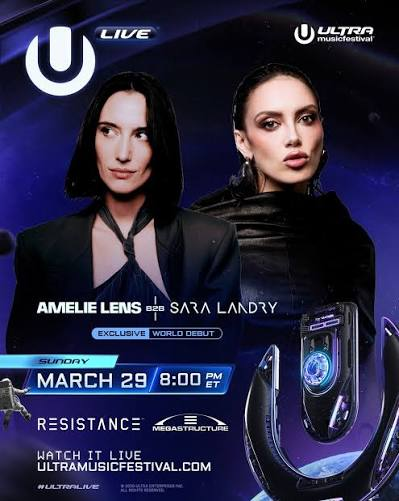
The Amelie Lens B2B Sara Landry World Premiere
Among the most significant of those world debuts was the first-ever back-to-back performance between Amelie Lens and Sara Landry — two of the most powerful forces in contemporary techno, artists who have each spent years demonstrating what it looks like to lead from the front of a genre still working to expand who gets to define it.
Amelie Lens has built one of the most consistent and respected careers in modern techno from her base in Belgium, with a sound defined by relentless precision, controlled intensity, and a commitment to the dancefloor that never gets diluted by the demands of festival spectacle. Sara Landry, the Austin-born, internationally touring techno force, has carved a path that is entirely her own — technically immaculate, emotionally powerful, and increasingly positioned among the genre’s elite performers on the world stage.
Their first-ever shared decks performance was the kind of pairing that fans had imagined long before it was announced and debated for months after the announcement confirmed it. When the two artists finally occupied the same stage in Miami, the set delivered everything the anticipation had promised. This was not a novelty booking or a promotional pairing built around name recognition alone. It was a genuine artistic collaboration between two artists whose approaches to the same music share enough DNA to create real chemistry and enough difference to create genuine tension and surprise.
TIMELESS: The Global Live Debut of Something Genuinely New
The second world premiere arrived from a different corner of the musical universe entirely, and it represents one of the more unexpected creative collaborations that Ultra has ever been positioned to unveil. Deorro, the Los Angeles-born producer and DJ whose career has moved fluidly between genres for over a decade; Mike Posner, the singer-songwriter who has reinvented himself multiple times but whose connection to dance music and its culture runs deeper than casual observers typically realize; and MORTEN, the Danish producer whose festival productions have established him as one of the hardest-hitting live presences in big-room electronic music — these three artists arrived at Ultra 2026 as TIMELESS, a brand-new collaborative project making its global live debut on one of the biggest stages in the world.
The audacity of launching a new creative project with a world premiere at Ultra Miami is itself a statement. There is no softer landing, no smaller venue to test the concept before the main event. TIMELESS chose to begin at the top, in front of tens of thousands of people and millions more watching the livestream, and the decision reflected a confidence in the material and the chemistry that only comes from genuine artistic conviction.
DJ Snake’s Underground Alter-Ego: Outlaw B2B TYRM Hits U.S. Soil
Among the U.S. debut moments that defined the weekend, the first American performance of DJ Snake’s underground techno alias Outlaw — performing back-to-back with TYRM — carried a particular weight for those who track what the French superstar does when he steps away from his better-known commercial identity.
DJ Snake is one of the most globally recognizable names in electronic music, with a catalog of crossover hits and a festival profile that places him among the world’s elite headliners. Outlaw is something else: a harder, darker, more deliberately underground expression that separates the artist from the audience expectations built around his main project. Bringing this alias to an American festival audience for the first time, paired with TYRM in a B2B format that pushes both artists toward their most uncompromising instincts, represented exactly the kind of curatorial risk that Ultra has always been positioned to take.
The set proved that the alias is not a side experiment or a calculated repositioning. It is a genuine artistic statement, and seeing it land at Ultra — in front of an audience that came in with one set of expectations and left with another — was one of the weekend’s more quietly consequential moments.
Adam Beyer B2B Joseph Capriati: A Techno Standard-Bearer
The U.S. debut of the Adam Beyer and Joseph Capriati back-to-back set belongs in any honest accounting of the weekend’s high points. Beyer, the Drumcode Records founder whose three-decade techno career has established him as one of the genre’s most respected and enduring figures, and Capriati, the Italian artist whose ability to move between driving techno and groove-heavy techno-house makes him one of the most versatile and compelling performers operating in that space — together, these two artists have a collaborative history and a mutual understanding of each other’s musical instincts that translates directly into the quality of the shared performance.
Their Megastructure set was everything that pairing promised on paper. Acid textures. Heavy bass. Soaring melodic moments that came and went without warning. Unreleased material tested in front of one of the most attentive crowds a new piece of music can find. Nostalgia touches deployed with surgical precision: Green Velvet’s “Percolator” resurfacing at exactly the right moment to remind a room why certain records have never stopped working.
The Moment That Stopped the Weekend: Swedish House Mafia and the Original Circle
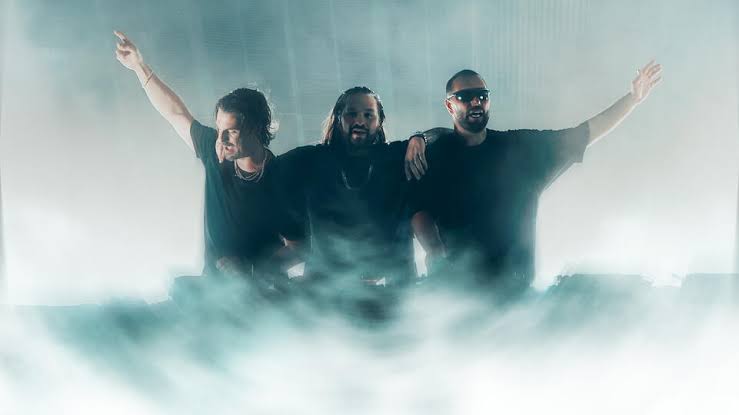
If Ultra 2026 belongs to any single moment, history will likely file it under Saturday night, Day Two, the Swedish House Mafia takeover of the Main Stage — and specifically, the appearance of Eric Prydz that transformed a headlining set into something that almost no one in attendance had a category for.
The setup requires some history. Eric Prydz, one of the most gifted and idiosyncratic figures in progressive house and electronic music across the past two decades, was part of the original circle of Swedish artists from which Swedish House Mafia eventually crystallized. He famously made the decision not to join the group as it formally coalesced in 2008, choosing instead to pursue the solo career that would produce “Pjanoo,” “Opus,” “Call On Me,” and the HOLO live experience — a body of work that stands comfortably alongside anything his former collaborators created in their own right. The two trajectories — SHM and Prydz — diverged in 2008 and had not meaningfully reconnected on a major stage since.
Ultra had announced the Saturday night slot as a Swedish House Mafia event billed as a “festival within a festival” — a curated takeover that began with a rare back-to-back between Steve Angello and Sebastian Ingrosso and was scheduled to include performances from Afrojack, Armand Van Helden, Boys Noize, Kelly Lee Owens, and emerging artist MPH. The announcement was already significant. Then, two days before the event, the confirmation arrived that Eric Prydz would join the stage as a special guest.
The electricity this created across the dance music community ahead of Saturday was substantial. But even with advance notice, the moment when it actually happened — when Axwell stood up on the decks and told the crowd that Prydz “used to be and forever will be a part of the original Swedish House Mafia,” as the Swede walked out to join his oldest collaborators — carried an emotional charge that advance preparation cannot fully account for.
The set that followed drew from the deepest wells of progressive house history. Prydz’s 2008 essential “Pjanoo” provided the backbone for an extended opening segment that wove together SHM classics and Prydz productions in a sonic conversation between two parallel careers that had spent seventeen years developing separately. The mashup of “Turn On the Lights again..” with “Pjanoo,” the appearance of “Leave the World Behind,” the eruption when “Opus” materialized — every moment carried the weight of history made visible.
Perhaps the most symbolically resonant moment came near the end, when Swedish House Mafia closed their set with a mix that wove “Don’t You Worry Child” into Avicii’s “Wake Me Up” — a song Avicii premiered at this exact festival thirteen years earlier. The crowd understood what was being said. The venue, and the occasion, made the tribute feel inevitable.
The full trio of Axwell, Steve Angello, and Sebastian Ingrosso closed out the night together, completing a set that the Miami Hurricane called “a gathering of lineage” — a description that captures what those in attendance actually felt more accurately than any straightforward review could.
Day One: Setting the Tone
The opening night of Ultra 2026 arrived with the kind of energy that years of anticipation can generate, and several performances managed to meet that energy precisely where it lived.
Eric Prydz’s standalone Megastructure set on Friday established the technical and emotional ceiling early. Dark, tunneling, futuristic — the set opened with what felt like a celestial entrance and escalated steadily into the kind of peak-time pressure that Prydz delivers better than almost anyone alive. He threaded classic vocal samples through original productions with the confidence of someone who has spent decades calibrating exactly how far to push a room before giving it what it needs. By the time the set ended, the Megastructure crowd had been given a masterclass in how this kind of music is supposed to feel.
The night’s most talked-about sequence arrived during BZRP’s main stage debut. Bizarrap — the Argentinian producer whose Music Sessions have quietly become one of the most culturally significant formats in contemporary pop music — built his Ultra premiere around a brand-new set created specifically for the festival, blending his signature sound with heavier electronic production in a way that felt genuinely designed for the main stage rather than simply transplanted onto it. When reggaeton legend Daddy Yankee appeared to perform the milestone BZRP Music Sessions collaboration, the crowd reaction was immediate and overwhelming.
But it was what happened at the very end that Ultra will likely replay for years. Skrillex materialized from nowhere — unannounced, unexpected, and utterly confident — and took over the final minutes of the set alongside Bizarrap. The two artists closed out the performance with Skrillex’s iconic remix of “Cinema,” a record that carries enough history to immediately reframe whatever moment it arrives in. It was the kind of surprise appearance that earns the phrase “you had to be there” in the most literal possible sense.
The Alesso and Martin Garrix back-to-back set that headlined the main stage on Friday night generated massive crowd energy and the kind of festival heat that only two artists with billions of streams between them can consistently produce. The pairing of two artists who have separately defined what progressive house means at stadium scale, sharing one stage for one of their rare joint performances, was the kind of main stage moment Ultra’s audience had been anticipating since the announcement. The set delivered on the spectacle. Music press observers noted that the duo leaned toward their most celebrated catalog rather than pushing into experimental territory — a creative choice that the crowd received with enormous enthusiasm, even as critics suggested the night’s biggest names might have found more interesting ground to cover.
Armin van Buuren’s Worldwide Stage set, celebrating the 25th anniversary of his A State of Trance brand, brought its own kind of history to the proceedings. Van Buuren’s two and a half decades of A State of Trance represent one of the most remarkable sustained creative enterprises in electronic music — a weekly broadcast and touring program that has maintained genuine influence and relevance across multiple generations of fans. His appearance at Bayfront Park honoring that milestone closed out Day One with the emotional register that the occasion demanded.
Day Two: The Cove, Carl Cox, and an Underground Afternoon
While Saturday night belonged to Swedish House Mafia, the daylight hours of Day Two offered their own rewards across the festival’s more intimate and specialized stages.
Deep Dish set the afternoon standard at the Cove stage with a performance that demonstrated precisely what the DC duo — Ali “Dubfire” Shirazinia and Sharam Tayebi — has always understood better than most: that the best house music does not age, it ripens. Their sunset set blended progressive house essentials from the ’90s with a looseness and confidence that only comes from thirty years of understanding how to play a crowd. Their remix of their own “Flashdance,” complete with guitar melody and Irene Cara sample, arrived like something excavated and restored. Their version of Stevie Nicks’ “Dreams” reminded everyone in earshot that the best catalog sets do not live in the past — they bring the past into the present tense.
Carl Cox’s Megastructure takeover is, at this point, one of the most reliable experiences in all of festival culture. The man has been behind the decks at Ultra more times than most attendees have been alive, and the quality of his work has not diminished by any measurable degree. His three-hour set on Saturday worked exactly the way three-hour Carl Cox sets always work: the opening establishes authority through simplicity — a bass, hi-hats, and a melody that rewires something in the brain. From there, the architecture builds. Acid. Dark groove. That unexpected salsa interpolation that sent the tent into genuine shock before resolving into the next technical move. By the end, the Megastructure had been through a complete emotional cycle and emerged ready to receive whatever came next.
The Underground, the Surprises, and the Breakouts
Ultra 2026 reinforced something that the festival has demonstrated consistently across its most successful editions: the moments that define a weekend are not always the ones that were advertised loudest. Several of the most discussed performances of the three days came from artists who arrived with less billing and left with significantly more attention.
Marlon Hoffstadt, the German artist who performs under the name DJ Daddy Trance, delivered what several critics and community observers identified as one of the weekend’s single most surprising performances. His high-energy, fast-moving, unashamedly fun techno set on Day Three generated the kind of crowd reaction that only happens when an artist exceeds expectations by a significant margin — not by subverting what they do, but by doing it better than anyone anticipated. In a weekend full of carefully constructed headline moments, his set stood out precisely because it felt genuinely spontaneous and alive.
Levity’s Live Stage performance offered a different kind of surprise — the emergence of an act that seemed to grow larger across the course of their set as more of the crowd arrived and the word spread. When Tape B materialized as a surprise guest to deliver a series of heavy bass track switches that shifted the entire temperature of the room, the Live Stage became momentarily the most important place at the festival. These are the micro-moments that Ultra regulars show up for: the unexpected intersection of two artists creating something that neither of them could have produced alone, in front of people who happened to be in the right place.
Boys Noize, fresh from a significant run of dates supporting Nine Inch Nails, brought a raw industrial electricity to his Live Stage performance that felt continuous with the kind of edge his recent work has been developing. The Industrial influence in his catalog and his touring context in the months before Ultra had sharpened something in the performance — it felt like an artist who had been playing in a specific register long enough for it to become genuinely his.
Day Three: Afrojack, Revelations, and John Summit Closes the Book
The final day of Ultra 2026 arrived with the specific energy that third days always carry — accumulated momentum from two nights and two days of continuous music, a crowd that has lost the self-consciousness of the first day and found something more primal in its place, and the knowledge that whatever remains of the weekend is finite and worth attending to fully.
Afrojack’s main stage closing set on Sunday brought a moment of genuine creative revelation. The Dutch producer used his platform to premiere a major new collaboration — a track called “Awake Tonight” featuring Sia, representing his first significant joint project with David Guetta in fifteen years. The significance of that timeline is hard to overstate for anyone who has followed the trajectory of both artists. “Titanium,” the collaboration Guetta and Afrojack produced with Sia in 2011, became one of the defining records of an entire era of dance music. A new collaboration between these artists — with Sia’s voice anchoring it — premiered live at Ultra Miami before any official release, delivered to an audience that understood exactly what it was witnessing, represents precisely the kind of cultural moment that the festival has always been positioned to host.
John Summit’s closing set functioned as the emotional conclusion of the entire weekend. The Chicago DJ has become one of electronic music’s most in-demand performers across the past few years, and his connection to crowd energy — the ability to read exactly what a room needs in real time and deliver it without appearing to calculate anything — was on full display across the final hours of Sunday night. New material from an upcoming album threaded through fan favorites in a set that built toward something inevitable, with “Where You Are” and “Shiver” marking the peaks of a run that concluded with Summit abandoning the stage entirely to join the crowd in the final minutes.
It is the kind of ending that cannot be scripted. It can only happen when an artist and an audience have built enough trust across the course of a set that the barrier between performer and participant stops functioning as a meaningful distinction. Ultra 2026 ended with that barrier dissolved, in the best possible way.
What It Means That Ultra Keeps Getting This Right
Ultra Music Festival is 27 years old. The genre it helped mainstream has changed beyond recognition in that time. The audiences who attend have shifted across multiple generations. The cultural context in which electronic music operates has expanded, contracted, splintered, and reconsolidated in ways that nobody in 1999 could have predicted. And yet the festival maintains its position as the benchmark event for what this music can accomplish when it is presented with the right resources, the right curation, and the right commitment to making things happen that have never happened before.
The 2026 edition understood something that events of this size often forget: scale is only a tool. What matters is what you do with it. Ultra had the largest livestream audience in its history. It had the largest slate of world-exclusive and U.S.-debut performances in recent memory. It had a surprise reunion moment that will circulate in the culture for years. And it had, across all three days, the consistent quality across multiple stages and dozens of artists that separates a great festival from a great lineup.
These are not the same thing. A great lineup is a list on a poster. A great festival is what happens when that list becomes an experience, when the programming choices create momentum that builds across three days, when the unexpected moments arrive with enough context to feel meaningful rather than merely surprising, and when the whole thing ends with the sense that something real occurred — not just something entertaining.
Ultra 2026 was the real thing. It was the kind of weekend that reminds the dance music world why Miami in March still matters more than anywhere else on earth, and why the festival that began with a few thousand people on a beach a quarter century ago still sets the standard for what this music deserves.
The next chapter begins March 26–28, 2027 at Bayfront Park in Downtown Miami. Tickets for the 27th edition are on sale now at ultramusicfestival.com.