
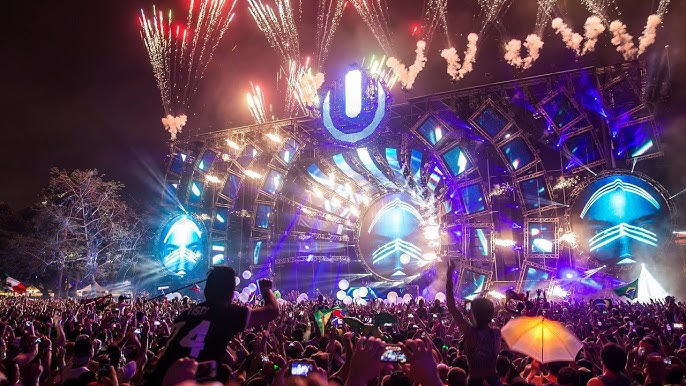
There is a specific kind of chaos that only Ultra Music Festival can generate, and most of it arrives on schedule. Pyrotechnics at midnight, confetti cannons on the drop, a headline act walking out to a crowd of fifty thousand people who have been waiting three hours for exactly this moment. The festival has built its reputation on delivering spectacle at a scale that few events on earth can match, and the crowd at Bayfront Park arrives every March knowing, more or less, what they are going to get. What happened on Saturday night in March 2014 was something entirely different. It was the night Joel Zimmerman, better known to the world as deadmau5, stepped into a last-minute booking and turned an act of goodwill into the single most discussed, most divisive, and most genuinely funny moment in the festival’s history.
The setup began with bad news. Avicii, at that point one of the most popular DJs on the planet and a confirmed headliner for Saturday night on the Ultra Main Stage, was hospitalized with acute pancreatitis shortly before he was scheduled to perform. The diagnosis was serious enough to pull him from the bill entirely, and Ultra organizers, working with a crowd already in place and a prime-time slot that needed filling, reached out to deadmau5 to step in as the emergency replacement closer. Zimmerman agreed. What the organizers did not fully account for was the mood he was in that afternoon, which he telegraphed clearly and publicly on Twitter before he ever touched a fader.
Before the set began, he was already on his phone. “Lemme know if Garrix plays Animals and the set contains at least one countdown from ten,” he posted, a pointed reference to Martin Garrix’s “Animals,” which at that moment was arguably the biggest electronic track on the planet and the song most synonymous with the big-room EDM sound that deadmau5 had spent years publicly criticizing. A second tweet followed shortly after: “I don’t even know what to play. I’ll figure it out I guess.” And then, with the kind of self-aware honesty that has always made Zimmerman a uniquely compelling public figure in a genre full of carefully managed images, a third: “Throwing some random bullshit together for the set. Holy shit, I’m such a dick, this is gonna be awesome.”
That last tweet, read in hindsight, was a complete preview of everything that was about to happen. When deadmau5 took the stage in his signature LED mouse head helmet and began his set, the crowd at Bayfront Park had no idea what was coming. The set opened in a way that felt relatively conventional, at least by deadmau5’s standards, before he began threading in references to the music and the culture he had been critiquing so vocally for years. The moment that made the night legendary came when “Animals” arrived in the mix. The crowd recognized the opening immediately. This was the song. This was the biggest drop in electronic music that year. The buildup climbed exactly as expected, the energy in the crowd spiked to match it, fifty thousand people braced for the impact of the drop that had been detonating festival moments all over the world for months. And then, at the precise instant the drop was supposed to hit, deadmau5 pulled “Old MacDonald Had a Farm” into the mix.
The version he played was the McMaNGOS Funnymals Edit, a fan-made rework that replaced the aggressive synthesizer drop of “Animals” with the melody of a children’s nursery rhyme, and the reaction from the crowd was instant and total. People who had been a fraction of a second away from losing their minds to one of the year’s biggest festival records found themselves listening to the sonic equivalent of a rubber chicken. The fact that deadmau5 had been publicly mocking “Animals” on Twitter for months before this moment made the execution feel premeditated in the best possible way. This was not a random technical glitch or an accidental slip of the mixer. This was a man who had accepted a headlining spot at one of the world’s most prestigious electronic music festivals and decided, with full intention and considerable glee, to use it to make a point.
The Avicii portion of the set generated its own controversy of a different kind. After the “Animals” moment, deadmau5 played a mashup of “Levels,” Avicii’s defining anthem, woven together with his own track “Ghosts N Stuff.” The intent behind this choice was genuinely ambiguous, and the ambiguity sparked an immediate reaction from other artists watching the performance. Tiësto, one of the most prominent figures in electronic music and someone who had performed at the same festival earlier that weekend, took to Twitter to question whether deadmau5 was mocking an artist who was recovering in a hospital bed. “Oh wait, was deadmau5 being sarcastic when he played Avicii? That’s pretty sad, taking the piss of someone who’s in the hospital,” Tiësto wrote. Deadmau5, characteristically undisturbed, replied: “How does one play a track sarcastically? Am I supposed to sneer while hitting the sync button? Or is that ironic?”
The exchange captured something real about who Joel Zimmerman is as a public figure in electronic music. He has always been constitutionally incapable of the kind of diplomatic image management that the festival circuit typically demands from its headliners. Where most artists at his level would approach a last-minute slot at Ultra with gratitude and professionalism, deadmau5 approached it as an opportunity to do exactly what he had been saying in interviews and on social media for years: demonstrate, through actual action rather than abstract criticism, what he thought about the direction mainstream EDM had taken. The “Animals” troll was not spite for spite’s sake. It was a thesis, delivered in the most theatrical venue imaginable, to the largest possible audience.
The electronic music world spent the following week arguing about it. Artists who had performed alongside deadmau5 that weekend were reportedly furious backstage. Critics and fans split along lines that largely reflected their existing views on the big-room EDM versus more progressive, atmospheric electronic music debate that deadmau5 had been one of the loudest voices in. Those who agreed with his cultural critique found the set brilliant and cathartic. Those who loved the music he was satirizing found it disrespectful and self-indulgent. Everyone agreed that nothing like it had ever happened on Ultra’s Main Stage before, and given the specific conditions that produced it, an emergency last-minute booking, a performer with nothing to lose and strong opinions to express, and the biggest festival stage in American electronic music as the delivery mechanism, nothing like it has happened since.
What makes the 2014 troll set permanently significant is not just what happened in the moment but what it revealed about Ultra as a space. The festival has always been defined by its ability to contain multitudes: the stadium singalong and the underground techno tent, the commercial pop crossover and the pure, uncompromising house set, existing within the same gates on the same weekend. The deadmau5 Saturday night slot added something else to that record, proof that Ultra is also a place where genuine, unscripted, unrepeatable human moments can still occur at the largest scale. The pyrotechnics are planned. The stage designs are engineered months in advance. But nobody planned for “Old MacDonald Had a Farm” to play out of the speakers at Bayfront Park to fifty thousand people who were expecting something else entirely, and nobody could have. That is what makes it the most distinctly Ultra thing that has ever happened at Ultra.
Eleven years later, at Ultra Miami 2025, deadmau5 was back on the same Main Stage. When “Animals” arrived in his set again, he pulled out the “Old MacDonald” edit one more time. The crowd reaction, according to everyone who witnessed it, was nearly identical to 2014: the buildup, the anticipation, the moment of recognition when the nursery rhyme arrived where the drop was supposed to be, and then the laughter and disbelief of an audience experiencing a joke they had been told about for over a decade finally landing in real life. The fact that the troll worked just as well the second time, with a crowd that largely knew it was coming, says something about how good the original joke was. A prank that survives the loss of surprise and still produces the exact same reaction is not just a prank. It is a piece of performance art with a real shelf life.
Joel Zimmerman has had one of the stranger and more genuinely interesting careers in electronic music, built on the tension between his obvious technical gifts as a producer and his equally obvious disdain for the commercial machinery that surrounds the genre he works in. The 2014 Ultra troll set is the moment where those two things came together most perfectly and most publicly. He was given the biggest stage in American electronic music on short notice, and he used it to say something. The fact that he said it by playing a children’s song at the exact moment fifty thousand people expected a festival banger is the part that makes it impossible to forget.
For anyone interested in the full Ultra Music Festival archive of performances and history, the official channels hold a remarkable record of everything the festival has produced across more than two decades in Miami.