
From a Beach Party to an Empire: The Complete History of Ultra Music Festival
Eight DJs. Two stages. Ten thousand people on the sand of South Beach. This is where it started. What happened next is one of the stranger and more consequential stories in American music history.
Russell Faibisch lost money the first year. By his own accounting, the inaugural Ultra Beach Music Festival ran a deficit despite drawing somewhere between ten and twenty thousand attendees to Collins Park on March 13, 1999. He came back the following March anyway. That decision, made by a man in his early twenties who had organized a one-day beach party named after a Depeche Mode album and found that people actually wanted what he was offering, is the origin point of one of the largest and most globally influential electronic music brands in history.
The Beach, the Band, and the Beginning
Russell Faibisch and Alex Omes had been building toward something like Ultra through the mid-to-late 1990s, promoting electronic music events around Miami through their production company and watching the scene grow faster than the venues and events around it could accommodate. The name they chose for their new festival came from Depeche Mode’s 1997 album, which Faibisch admired deeply, and the choice said something about the sensibility behind the event: this was not branding generated by a committee. It was a genuine cultural reference point from a founder who cared about the music and wanted the festival to announce that fact from the outset.
The inaugural edition was a single-day event spread across two stages at Collins Park, featuring eight DJs. The headliners included Paul van Dyk, one of trance music’s most globally respected figures; Rabbit in the Moon, the Miami-based duo who had been central to the city’s electronic scene since the early 1990s; and Josh Wink, the Philadelphia producer whose work had been defining progressive house and techno for most of the decade. These were not compromise bookings. They were legitimate representatives of the music that actually mattered in that scene at that moment, which immediately distinguished the festival from the promotional events around it.
The attendance figure, somewhere between ten and twenty thousand people by various estimates, completely exceeded what Faibisch and Omes had planned for. The logistics of a beach event at that scale were not designed for a crowd that size, the budget had not accounted for what it cost to serve that many attendees, and the result was a deficit. Most rational business assessments of that outcome would have produced a decision to not repeat the experiment. Faibisch returned to Collins Park the following year, drew a larger crowd, lost somewhat less money, and then in 2001 made the decision that would define everything that came after it: he moved the festival across the causeway to downtown Miami.
Ultra Music Festival was named directly after the 1997 Depeche Mode album, “Ultra,” by co-founder Russell Faibisch, who was a devoted fan of the band. The connection between a synth-pop record from Basildon, England, and the world’s most prominent electronic dance music festival is rarely mentioned in contemporary coverage of the event, but it is the literal source of the name that now appears on festival posters across six continents.
Moving Downtown and Building the Machine
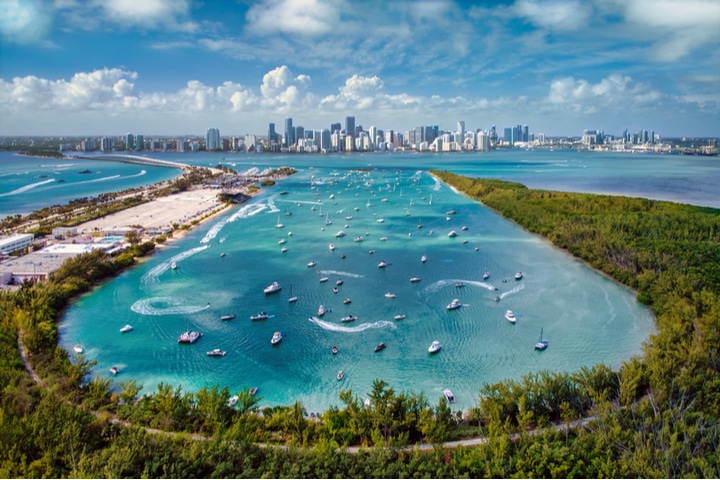
Bayfront Park sits on the western edge of Biscayne Bay in downtown Miami, a few blocks from the financial district, with the bay on one side and the city’s skyline visible from almost every point within the grounds. When Faibisch and Omes relocated Ultra there for the third annual edition in 2001, they gave the festival a home that would prove extraordinarily well-suited to the scale it was building toward: an open waterfront space, visually dramatic, logistically accessible from the city’s downtown infrastructure, and large enough to accommodate growth that Collins Park could never have absorbed. The park had hosted major outdoor events before and had the municipal relationships in place to support the operational complexity of a major festival.
Between 2001 and 2005, the festival grew steadily in both scale and ambition. The programming expanded from one day to two days. The headliner roster began pulling from the upper tier of global electronic music: Tiësto, then in the early years of the career that would make him one of the most recognized DJs on earth; Kraftwerk, the German group whose influence on every genre Ultra would eventually platform is essentially impossible to overstate; and The Chemical Brothers, whose live production set a standard for what an electronic act could do on a stage at size. These were bookings that signaled the festival’s programming ambitions clearly. This was not a local event with national aspirations. It was building toward something global from the inside of a park in downtown Miami.
Breaking Records and Going Global
By 2007, the festival’s attendance had broken 50,000 for the first time, a number that Bayfront Park could not responsibly accommodate and that triggered the move to Bicentennial Park, a larger site just north of the original downtown location. The new venue gave the production team room to operate at a scale that better matched what the lineup and the audience had become. The stages grew. The production values escalated. The programming expanded across more genre channels simultaneously. And in 2011, the festival took the step that formalized what it had been becoming for years: it extended to three days and sold out over 100,000 tickets essentially the moment they went on sale, before any lineup had been announced.
That last detail matters. Selling out a three-day festival with six-figure attendance before announcing who would perform is not a product of marketing. It is a product of trust, earned across twelve years of consistently delivering an experience that justified the price and the commitment. By 2011, Ultra’s reputation was strong enough that its audience was willing to purchase tickets to a weekend defined solely by the fact that Ultra was the organizer. The lineup was secondary. The brand itself had become the guarantee.
The global expansion that followed was a logical extension of that brand credibility into new markets. The Ultra Worldwide model uses a franchise structure that exports the festival’s main stage design language, production standards, and RESISTANCE underground programming to partner organizations in cities around the world while maintaining centralized quality control over what the experience delivers. The first major international editions launched in the early 2010s, establishing a presence in Brazil, South Korea, Japan, and South Africa within a few years. By 2026, Ultra Worldwide was running active multi-day editions across six continents, with confirmed dates in Santiago, Lima, Guatemala City, Mexico City, Tokyo, Cape Town, Johannesburg, and multiple Oceania markets including the inaugural Ultra New Zealand edition. The festival that Faibisch and Omes organized on a Miami beach in 1999 now occupies a permanent position on the annual event calendar of most major metropolitan areas in the electronic music world.
Selling out a three-day festival before announcing the lineup is not a product of marketing. It is a product of twelve years of trust, earned one March at a time on the waterfront of downtown Miami.
The Moments That Defined the Festival
Ultra’s historical significance is not just a function of scale or longevity. It is the accumulation of specific moments that happened at Bayfront Park and nowhere else, moments that the electronic music community references years and decades later because they captured something real about the culture at a specific point in time.
In 2012, Madonna appeared on the main stage to introduce Avicii during a set that positioned Ultra squarely in the intersection between underground electronic music and global pop culture. The appearance itself was electric. What followed was a media firestorm: from the main stage, Madonna asked a crowd of tens of thousands how many people had seen Molly that night, a reference that sent the festival directly into a national news cycle about dance music culture, drug use, and the responsibilities of artists at events of this scale. The controversy was significant enough to generate a formal public response from Madonna’s representatives and to draw sustained coverage from outlets well outside the music press. For Ultra, the moment was a turning point in visibility, placing the festival’s name in front of an audience that had never heard of it and making it impossible to ignore as a cultural phenomenon. Whether any individual assessment of what happened that night was fair or not, the result was that Ultra became a subject of national conversation in a way that no electronic music festival in America had previously achieved.
Two years later, in March 2014, Avicii was hospitalized with acute pancreatitis in the days before the festival and was unable to perform his headlining main stage slot. The medical emergency was genuine and serious, and Ultra organizers scrambled to fill one of the biggest slots of the weekend. deadmau5, whose actual name is Joel Zimmerman and whose public skepticism about the direction mainstream EDM had been taking was well-documented across years of interviews and social media activity, stepped in as the replacement. Before taking the stage, he telegraphed his intentions publicly on Twitter, writing that he would be throwing some random things together and that the result was going to be interesting. When the moment came in his set, he let Martin Garrix’s “Animals,” the biggest electronic track of that year, build to its expected drop, then replaced the aggressive synthesizer impact with the melody of “Old MacDonald Had a Farm.” Fifty thousand people who had been preparing to lose their minds to one of the year’s most recognizable festival records found themselves listening to a nursery rhyme. The version he played was a fan-made edit called the McMaNGOS Funnymals Edit, and he had clearly prepared it in advance. The reaction was immediate, polarizing, and permanent: it has been circulating in the electronic music community’s cultural memory ever since. When deadmau5 returned to the Ultra main stage in 2025, he played the same edit again. The crowd, many of whom knew it was coming, reacted identically.
For the 20th anniversary edition in 2018, Ultra left the closing slot of Sunday night completely blank on the publicly released schedule. No name, no hint, no announcement. In the weeks before the festival, the three-circle logo associated with Swedish House Mafia, the Swedish progressive house trio of Axwell, Sebastian Ingrosso, and Steve Angello who had formally disbanded after their One Last Tour in 2013, began appearing on walls and surfaces around Miami. The group’s management denied a reunion was happening. Steve Angello denied it on Twitter. Then, on Sunday night at 10 PM, the lights came up, and Axwell stepped to the microphone. “I am Axwell. I am Sebastian Ingrosso. And I am Steve Angello. And Miami, tonight we go by Swedish House Mafia.” The crowd reaction that followed has been described, by people who covered the event professionally, as the loudest sound they had ever experienced at a live music event. The set ran through “Save the World,” “Miami 2 Ibiza,” “Greyhound,” and closed with a fireworks-accompanied performance of “One (Your Name).” By the time it ended, Swedish House Mafia was the top trending topic globally on Twitter and had confirmed a full reunion tour that would extend through 2019.
The 2018 reunion at Ultra carries particular significance beyond its immediate spectacle because it illustrates something specific about what the festival has built over its history: the relationship between Ultra and the electronic music community is deep enough, and the festival’s main stage carries enough weight, that an announcement made there carries cultural authority that announcement made elsewhere would not. Swedish House Mafia did not reunite at a press conference or through a social media post. They reunited on the Ultra main stage during the 20th anniversary closing set, because that stage was the right stage for a moment of that magnitude. The festival’s last year as a group had also concluded at Ultra, in 2013. The symmetry was intentional, and it worked because Ultra had spent twenty years making that stage the kind of place where symmetry like that could mean something.
The RESISTANCE Megastructure
Ultra’s physical production has evolved in parallel with its programming and attendance, and the crown achievement of that evolution is the RESISTANCE Megastructure, a permanent installation designed by production architect Stephen Lieberman that functions less like a festival tent and more like a purpose-built indoor venue that happens to be installed and removed each March.
The Megastructure is an enclosed, hangar-scale structure whose interior ceiling is packed with kinetic production elements: lighting rigs, trussing systems, video screens, and panels that are engineered to physically move during performances, tilting, descending, and reconfiguring as the production demands. The effect in person has been consistently described as immersive in a way that most outdoor festival environments cannot achieve, because the standard festival experience, with its open sky and visible horizon, creates a fundamental disconnect between the scale of the production and the infinity of the space it sits within. The Megastructure eliminates that disconnect by containing the experience, concentrating the sound and light and visual production within a defined volume, and then flooding that volume with more simultaneous production elements than most indoor arenas attempt in a single show. Artists who perform in the Megastructure are not playing in front of a backdrop. They are performing inside a production environment that responds to them in three dimensions simultaneously.
The stage has housed some of the most significant performances in the festival’s history, including Carl Cox’s legendary multi-hour sets that have become annual reference points for the techno community, and the Adam Beyer and Joseph Capriati back-to-back that made its U.S. debut at Ultra 2026 to an audience that had been waiting years for it. It has become the home of the RESISTANCE underground programming brand that runs in parallel with the main stage headliner programming each year, offering a deeper, harder, more club-focused experience within the same festival grounds. The Megastructure’s design influenced how other festivals approached large-scale covered production environments in the years following its introduction, in the same way that Ultra’s early investment in broadcast infrastructure influenced how other events approached livestreaming.
Ultra Today and What Comes Next
The 26th edition of Ultra Music Festival in March 2026 drew 165,000 people across three days at Bayfront Park and reached a combined global audience of 42.5 million through the UMF TV livestream. Miami-Dade County designated March 28 as Ultra Music Festival Day in a ceremony with County Commissioner Vicky L. Garcia. The festival’s Mission: Home sustainability program, in its seventh year of operation, ran 65 simultaneous environmental initiatives, deployed the first zero-emission battery-powered large-scale stage in American festival history, and picked up its 11th industry sustainability recognition. The 26th edition delivered five world-premiere performances, including the first-ever Amelie Lens and Sara Landry back-to-back set, the global live debut of the TIMELESS supergroup project, and a surprise Swedish House Mafia reunion during the Eric Prydz main stage set that generated the kind of crowd reaction that only Ultra’s specific history with that group could produce.
The 27th edition is already confirmed for March 26, 27, and 28, 2027, at Bayfront Park. Tier 1 and Tier 2 tickets have sold through. The Winter Music Conference, now in its 37th year, has confirmed its return for the same week, running March 24 through 26 at the Kimpton EPIC and feeding directly into the Ultra weekend. No lineup has been announced yet, which is standard for this point in the calendar. Ultra typically releases its Phase 1 booking announcement in December or January, and given what the 26th edition delivered in terms of world debuts, reunion moments, and headline pairings, the expectations for the 27th are not small.
What Russell Faibisch started on the sand of Collins Park in 1999, with eight DJs, two stages, a budget that ran a deficit, and a name borrowed from a Depeche Mode record, now reaches every inhabited continent on earth, generates audiences in the tens of millions, and occupies a permanent position in the cultural infrastructure of global electronic music. The distance between those two facts is the history of Ultra Music Festival, and it is not finished yet.
March 26, 27, and 28 at Bayfront Park in Downtown Miami. Tickets are available now in limited quantities. The lineup drops in winter.
Get Your 2027 Tickets